Showing posts with label Mythical Zone. Show all posts

Chimera

Chimera


The Chimera, in mythology, is a Greek monster with the body and head of a lion with a snake for a tail and a fire-breathing goat head coming from its back. Different versions of Chimera mythology have slightly different descriptions, such as wings on the back or the back legs of a snake, but most follow the description above.

No matter how you describe it, the Chimera is the daughter of Greek monster gods Typhon and Echidna, which means its siblings include other famous Greek monsters such as The Sphinx, Cerberus, and Ladon.

Merely seeing the Chimera was a bad omen. The Greek monster regularly appeared before disasters such as shipwrecks, violent storms, and volcanic eruptions.

The most famous moment involving the Chimera in Greek mythology is when the Greek hero Bellerophon, with the help of his trusty winged steed, Pegasus, killed the Chimera with a bow and arrow from the sky above.

Beyond mythology, the term "chimera" is used in scientific research to explain an animal that contains more than one set of genetic codings. This is a clear nod to the Greek monster, in that the monster itself is a combination of three different 'normal' animals.

The use of the word "chimera" as a way of describing a hybrid "monster" of sorts seems to be the most lasting element of the Chimera mythology. In later medieval usage, the word was used to describe any hybrid monster combination, and had a deep connection to the evil and demonic. There are many hybrid monsters, even if you just look at Greek monsters alone, so it's somewhat interesting that the Chimera was the one of all of them to end up defining a term that is still used in multiple purposes today.

Charybdis

Charybdis


Charybdis (Greek mythology) is one of several Greek monsters that appeared in multiple famous myths, such as "The Odyssey" and "Jason and the Argonauts". She is often known only in her most vicious form - a swirling whirlpool of death that swallowed enormous amounts of water and anything that got caught in it.

She wasn't always this way. Originally she was a naiad, a water nymph, and the goddess of the tide. She was the beautiful and immortal daughter of the sea god Poseidon (Greek mythology) and the earth goddess Gaia (Greek mythology). In this form, she served her father as something of a conqueror in his quest for dominance of sea over land. Poseidon would create storms on the sea which his daughter would ride onto the land, flooding and inundating towns, forests, and beaches alike.
She was so successful that Zeus took notice of her claims on his land and grew furious. He transformed her into a sea monster, a giant bulbous beast with a giant mouth, and chained her to the bottom of the sea in the Strait of Messina. Three times a day her sea monster form would suck down water from the sea and spit it back out, forever continuing her duties of creating the tides, but swallowing anything that got caught in her whirlpool.

Charybdis famously sits directly across the Strait of Messina from another sea monster, Scylla. Together they make travel through the Strait a nightmare decision - be eaten by Scylla or swallowed by the whirlpool.

In The Odyssey, the hero Odysseus chooses to sail closer to Scylla and lose a few of his men rather than risk his entire ship swallowed up in the inescapable whirlpool. The Argonauts, with help from Hera (Greek mythology) were able to avoid both sea monsters altogether.

Cerberus

Cerberus


Cerberus (Greek mythology) is best known as the guardian to the gates of Hades (the Underworld).
In Greek mythology Cerberus is depicted as a dog with three ferocious heads and the tail of a snake. He is one of the great Greek monsters born unto Typhon and Echidna.
His sole task is essentially be the "bouncer" of Hades. As the rules go, only the dead may enter the Underworld, and none may leave.

There are only a couple of myths in Greek mythology where a hero gets the better of Cerberus. The first is when Orpheus (Greek mythology), the famed musician, sneaks into Hades by lulling the usually unstoppable Cerberus to sleep with his beautiful music.

The second myth is when Hercules (Greek mythology), with the approval of Hades (Greek mythology), the god of the Underworld, gets Cerberus in a choke hold, knocks him out, and kidnaps him. He is eventually returned to his post where he remains to this day.


Other than these myths, the three-headed hound of Hell is an unmatched force for anyone trying to get in or out of Hades without express permission.

In vampire mythology, it is said that the souls of all vampires are held in a container (a coffin, appropriately), somewhere in Hades. According to the Vampire Origin Story, because of a deal made by the first vampire, if any vampire should ever return to Hades they can get in (because technically they are dead), but they can never leave again.

Some believe that due to his unmatched dedication to the gods of ancient Greece, Cerberus was eventually released by Hades and was able to join the gods in a more human immortal form, thereafter being known by the name Naberius.

Centaur

Centaur


Centaur mythology revolves around half-horse / half-human creatures whose origin is little understood.

In ancient Greek mythology centaurs are basically frat boys with horse bodies. I'm talking the body of a horse up to its neck, then the torso, head, and arms of a total human being.

In general they were wild and rude, loud and unruly, and generally just liked to run around the countryside getting drunk and being jerks.

There was one key exception and that was Chiron, who was pretty much the exact opposite of all the other centaurs. He was smart, well-spoken, skilled in art and music, and on top of it all he was kind and friendly to all humans. People liked Chiron so much that the higher class citizens, including many of the demi-gods, had him tutor their children. Among the more famous names were Aesculapius, who became the god of medicine, and the immortally strong Hercules.

Chiron is often mistakenly credited as the figure in the Sagittarius myth, when he is actually the figure in the constellation Centaurus.

Either way he is the exception to the centaur rule. The rest of his kind were loud, obnoxious, and often drunk. One famous story told of Hercules swiping some centaur wine and getting into a huge brawl over it. The lesson? Never take a drunk's wine. Especially that of someone who is half-horse.

Later legends show more evolved centaurs who are not quite as wild, but just as dangerous. These centaurs are more focused hunters, though for the most part they aren't particularly crazy about humans.

Except for Amazons. Apparently, Amazons, the wild warrior women of myth, play a key part in late centaur mythology. They are the lovers of male centaurs. Try not to picture what that looks like, it's probably illegal.

There's not a lot more to say about them other than the fact that despite being legendary monsters from thousands of years ago, most people know enough about centaur mythology to at least know what a centaur is. That's actually a pretty good accomplishment.

If you don't believe me, ask the next person you see if they know what a centaur is. Chances are they might not know their history, but they'll know they are half-men/half-horses. Then ask that same person what a basilisk is. Both creatures are from the same era known to many of the same ancient peoples, but the truth is that most people won't know what you are talking about. And by now they are probably going to be looking at you funny wondering why you are asking them such strange questions.

The point is - centaur mythology has been around for a very long time, and shows no sign of going away any time soon.

Golem

Golem


The term "golem" is largely misunderstood due in part to the difference between popular uses of the moniker in different mythologies.

In its original and primary meaning, a golem is a humanoid creature made of some sort of inanimate mineral and brought to life through magic. A person with the right skills could build "person" out of sand, dirt, clay, stone, or like material and then magically animate and controlling the creature. Golems can be brought to life through various magical methods, but the most common is either etching a magic word into their foreheads or writing a magic word on a piece of paper and putting it in their mouths.

Golems first appeared in Jewish mythology, with the most famous being the Golem of Prague. According to legend, this clay creature was created in the late 16th century by Judah Loew ben Bezalel, the chief rabbi of Prague, to protect the Jews in Prague from persecution by the Roman Emperor. Various versions of the tale exist, but it seems to end with the Emperor begging the Rabbi to deactivate the the creature in exchange for the end of the persecution. To do so, the Rabbi removed the first letter from the magic word on the golem's forehead, changing it from "emet" (truth, real) to "met" (dead). This deactivated creature is said to still exist in the attic of the Old New Synagogue in Prague, able to be reactivated by someone with knowledge of the proper activation ritual. The attic is not open for public viewing.

More modern recreations of golem mythology have made of various materials such as lava or ice, but most commonly they are made of clay or stone. Kevin Smith's 1999 movie "Dogma" even features a golem made of... how to say this nicely... human excrement. Okay, that's definitely reaching pretty far, but it goes to show that golems can be created out of just about anything.

An important note about golems is that they do not have a mind of their own. They are quite like robots in the sense that they can't think for themselves, they can only follow commands. It is important also to remember that golems take their orders literally. Their controllers must be very specific so the golem doesn't cause more trouble than it helps.

One of the most popular references to the name "golem" comes in J.R.R. Tolkien's classic "Fellowship Of The Rings" series. In it a creature known as "Golem" plays a central role in the primary quest of the main characters, but is not in any way the same as the golems discussed thus far. Most likely this use of the term comes from the old use of "golem" as an insult towards people who don't think for themselves. Tolkien's "Golem" was once a human that was so obsessed with the power of a magical ring that he lost his ability to think of anything else.

Bigfoot

Bigfoot


A very large, hairy, humanoid creature from North American folklore reputed to inhabit wilderness areas of the U.S. and Canada, esp. the Pacific Northwest. Also, known as Big Foot, Sasquatch,The Abominable Snowman, or Yeti.

Yeti
The Abominable Snowman, or Metch-Kangmi in Tibetan, is a huge, hairy creature that walks upright and haunts the snow-capped peaks of the Himalayas. For years explorers have reported footprints measuring as much as 12½ by 6½ inches in the snow.

While leading an expedition on Mt. Annapurna in 1970, Don Whillans spotted a large, furry creature walking on two legs on a nearby mountain. He watched through binoculars for half an hour before the "snowman" vanished in a clump of trees.

Scientists believe bears, which can walk on two legs, could have left some of the footprints. Other observers suggest wolves, goats, snow leopards, or perhaps falling rocks or snow could be responsible. However, the Sherpa people of the region have traditionally believed that the Himalayan peaks are haunted by demons and spirits, while the Yeti, an ancient beast, prowls the mountains.

Yeren

Variously referred to as the Yiren, Yeh Ren, Chinese Wild man, "The Wild man of Shennongjia", Man-Monkey or "Man Bear" is said to be an as yet undiscovered hominid in China's remote mountainous and forested Hubei province.

Many people think that there is a species and that the Yeti, Bigfoot, Yeren, Yowie, etc, are all related somehow and that when all the continents were together they traveled to different places and adapted very quickly. This theory has not been proven yet but many people believe it to be true.

Mermaid

Mermaid


A mermaid (from the Middle English mere in the obsolete sense 'sea' + maid(en) is a legendary aquatic creature with the head and torso of human female and the tail of a fish. The male version of a mermaid is called a merman; the gender-neutral collective noun is merfolk. Various cultures throughout the world have similar figures.

In some ancient cultures Mermaids were regarded as semi-divine aspects of the Goddess, connected to the sea from which life arises and honored in seaside temples. The earliest Mermaid story comes from Assyria around 1000 BCE. Atargatis, an Assyrian priestess, jumped into the sea to wash away the shame of an unwanted pregnancy and emerged as a fishtailed goddess. In the 2nd century BCE, the Greek historian Lucian reported that the statue of the Great Goddess at the temple of Hieropolis (which is now modern Turkey) had a fishtail instead of legs. In Greece, Aphrodite, the goddess of love, as born from the sea foam and rode to land on a half-scallop shell.

In the 1st century CE, Pliny wrote convincingly of the existence of Mermaids, but said that their bodies were 'rough and scaled all over'. But by the 5th century CE, the bestiary Physiologus described Mermaids in terms that accord fully with their contemporary image. Mermaids are 'wonderfully shaped as a maid from the navel up and fish from the navel down'.

Mermaids were often sighted by seamen during the middle ages, Christopher Columbus among them, who reported seeing three Mermaids on his first voyage to the Americas in 1493. Mermaids figured prominetly in sailors' lore, because of such travellers' tales. The most common story was that Mermaids were incredibly skilled at seducing lonely sailors and dragging them down to their underwater kingdom. It was also believed that they could cause storms and shipwrecks. These beliefs were reinforced by the medieval Church, to which Mermaids were an emblem of vanity, lust and the spiritual perils of women and of sexuality.

The Sirens of Greek mythology are sometimes portrayed in later folklore as mermaids; in fact in some languages the name sirena is used interchangeably for both creatures. Other related types of mythical or legendary creature are water fairies (e.g. various water nymphs) and selkies.

Basilisk

Basilisk


The basilisk appeared in various forms throughout history. Is started off as a small crowned snake being able to kill with its lethal poison and evil gaze. The poison was so lethal, it left a wide trail of venom in its wake.
Later on, the medieval travelers described it as a large, fire breathing creature with a terrifying roar.
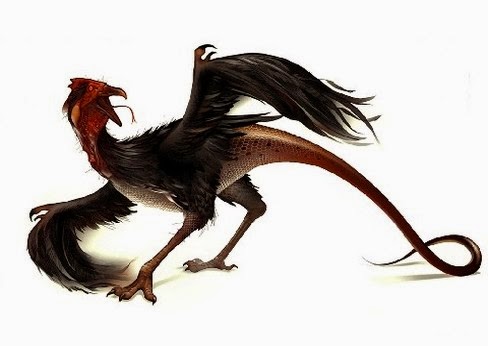
The description changed even further, creating a rooster with a serpent's tail and (occasionally) dragon wings. This shows similarities with the cockatrice, but there is one difference. The basilisk is said to be hatched from the egg of a rooster (yes, rooster, not chicken) and incubated by a toad, while the birthing process of a cockatrice is vice versa, a toad's egg hatched by a rooster.
In the meantime another appearance has been made up, a lizard, with a rooster's head, the tail of a serpent and eight chicken legs. This lead to its looks in the popular culture, making it a large, six- or eight-legged lizard, armed with a petrifying gaze.
The tales about the basilisk and the mirror really exist, but it can be slayed by other various methods. It is also vulnerable to the cockcrow of a rooster. This belief lead to travelers carrying roosters for self protection.
It can also be stopped by the odor of a weasel. The villagers threw it in the pit (recognized by the dying vegetation nearby) of the basilisk in hope to get rid of the beast. The weasel itself usually kills the basilisk on its own as well by urinating on the monster, but this almost always leads to the death of the mammal.
Other interesting facts are, that the basilisk can only be a male, for it must have the most proper receptacle of venom and destructive qualities. Its is also said to be so evil, that when it cannot gaze animals to death it turns to plants, withering them anywhere it goes.
The basilisk is believed to be the most poisonous creature ever lived, there are tales where the basilisk was killed by a spear from horse-back, but the poison flowed upward and killed both the man and the ride. Its presence is so tainting, that not only herbs die of its terrible breath, but stones shatter as well. The basilisk's venom is so strong, that upon drinking from a well, the water remains polluted for centuries, bringing death to anyone drinking it.
Despite its cruel nature, it still resembles power (and sometimes that of hell in christian mythology), thus it became the guardian creature and the traditional symbol of the Swiss city Basel.

Greek Gods and Goddess List


List of Greek Gods and Goddesses - A

Achelois - One of the moon goddesses.

Achelous - The patron god of the Achelous river.

Aeolus - (a.k.a. Aeolos, Aiolos, Aiolus, Eolus) God of air and the winds.

Aether - (a.k.a. Aither, Akmon, Ether) God of light and the atmosphere.

Alastor - God of family feuds.

Alcyone - One of the seven daughters of Atlas and Pleione.

Alectrona - Early Greek goddess of the sun.

Amphitrite - (a.k.a. Salacia) The wife of Poseidon and a Nereid.

Antheia - Goddess of gardens, flowers, swamps, and marshes.

Aphaea - (a.k.a. Aphaia) A Greek goddess who was worshipped exclusively at a single sanctuary on the island of Aegina in the Saronic Gulf.

Aphrodite - (a.k.a. Anadyomene, Turan, Venus) Goddess of love and beauty.

Apollo - (a.k.a. Apollon, Apulu, Phoebus) God of the sun, music, healing, and herding.

Ares - (a.k.a. Enyalius, Mars, Aries) God of chaotic war.

Aristaeus - (a.k.a. Aristaios) Patron god of animal husbandry, bee-keeping, and fruit trees.

Artemis - (a.k.a. Agrotora, Amarynthia, Cynthia, Kourotrophos, Locheia, Orthia, Phoebe, Potnia Theron) Goddess of the moon, hunting, and nursing.

Asclepius - (a.k.a. Aesculapius, Asklepios) God of health and medicine.

Astraea - The Star Maiden - a goddess of justice, included in Virgo and Libra mythologies.

Até - Goddess of mischief.

Athena - (a.k.a. Asana, Athene, Minerva, Menerva) Goddess of wisdom, poetry, art, and the strategic side of war.

Atlas - The Primordial Titan who carried the world on his back.

Atropos - (a.k.a. Aisa, Morta) One of The Fates - She cut the thread of life and chose the manner of a persons death.

Attis - The (minor) god of rebirth.

List of Greek Gods and Goddesses - B


Bia - The goddess of force.

Boreas - (a.k.a. Aquilo, Aquilon) The North Wind. One of the Anemoi (wind gods).

Brizo - Protector of Mariners.

List of Greek Gods and Goddesses - C


Caerus - (a.k.a. Kairos, Occasio, Tempus) The (minor) god of luck and opportunity.

Calliope - One of the Muses. Represented epic poetry.

Calypso - (a.k.a. Kalypso) The sea nymph who held Odysseus prisoner for seven years.

Castor - (a.k.a. Castore, Kastor) One of the twins who represent Gemini.

Celaeno - The name of a wife of Poseidon.

Cerus - The wild bull tamed by Persephone, made into the Taurus constellation.

Ceto - (a.k.a. Keto) a sea monster goddess who was also the mother of other sea monsters.

Chaos - (a.k.a. Khaos) The nothingness that all else sprung from.

Charon - (a.k.a. Charun) The Ferryman of Hades. He had to be paid to help one cross the river Styx.

Chronos - (a.k.a. Chronus, Khronos) God of time.

Circe - (a.k.a. Kirke) A goddess who transformed her enemies into beasts.

Clio - One of the Muses. She represented History.

Clotho - (a.k.a. Nona) One of the Fates - Spun the thread of life from her distaff onto her spindle.

Crios - The crab who protected the sea nymphs, made into the Cancer constellation.

Cronus - (a.k.a. Cronos, Kronos, Saturn) God of agriculture, father of the Titans.

Cybele - (a.k.a. Agdistis, Magna Mater, Meter, Meter Oreie) Goddess of caverns, mountains, nature and wild animals.

List of Greek Gods and Goddesses - D


Demeter - (a.k.a. Ceres, Demetra, Tvath) Goddess of the harvest.

Dinlas - Guardian of the ancient city of Lamark, where wounded heroes could heal after battle.

Dionysus - (a.k.a. Bacchus, Dionysos, Liber) God of wine and pleasure.

Doris - A Sea Nymph, mother of the Nereids.

List of Greek Gods and Goddesses - E


Eileithyia - (a.k.a. Eileithyiai, Eilithia, Eilythia, Eleuthia, Ilithia, Ilithyia, Lucina) Goddess of childbirth.

Eireisone - The deity who embodied the sacred ceremonial olive branch.

Electra - (a.k.a. Atlantis) One of the seven Pleiades.

Elpis - (a.k.a. Spes) The spirit of Hope.

Enyo - (a.k.a. Bellona) A (minor) goddess of war, connected to Eris.

Eos - (a.k.a. Aurora, Eosphorus, Mater Matuta, Thesan) Goddess of the Dawn.

Erato - One of the Muses - represents Lyrics/Love Poetry.

Erebus - (a.k.a. Erebos) God of darkness.

Eris - (a.k.a. Discordia) Goddess of strife, connected to Enyo.

Eros - (a.k.a. Amor, Cupid, Eleutherios) God of love, procreation and sexual desire.

Eurus - (a.k.a. Euros, Vulturnus) The East Wind - One of the Anemoi (wind gods).

Euterpe - One of the Muses - represents Music/Lyrics/Poetry.

List of Greek Gods and Goddesses - G


Gaia - (a.k.a. Celu, Gaea, Terra) Goddess of the Earth, also known as Mother Earth.

Glaucus - (a.k.a. Glacus, Glaukos) A fisherman turned immortal, turned Argonaut, turned a god of the sea.

List of Greek Gods and Goddesses - H


Hades - (a.k.a. Aita, Dis Pater, Haidou, Orcus, Plouton, Pluto) God of the Dead, King of the Underworld.

Harmonia - (a.k.a. Concordia) Goddess of Harmony and Concord.

Hebe - (a.k.a. Juventas) Goddess of youth.

Hecate - (a.k.a. Hekat, Hekate, Trivia) Goddess of magic, witchcraft, ghosts, and the undead.

Helios - (a.k.a. Sol) God of the Sun.

Hemera - (a.k.a. Amar, Dies, Hemere) Goddess of daylight.

Hephaestus - (a.k.a. Hephaistos, Vulcan, Sethlans, Mulciber) God of fire and blacksmithing who created weapons for the gods.

Hera - (a.k.a. Juno, Uni) Goddess of goddesses, women, and marriage and wife of Zeus.

Heracles - (a.k.a. Herakles, Hercules, Hercle) An immortal hero of many Greek legends, the strongest man on Earth.

Hermes - (a.k.a. Pyschopompus, Mercury, Turms) God of commerce and travel, and messenger of the gods.

Hesperus - (a.k.a. Hesperos, Vesper) The Evening Star.

Hestia - (a.k.a. Vesta) Greek goddess of the home and fertility. One of the Hesperides.

Hygea - (a.k.a. Hygieia, Salus) Goddess of cleanliness and hygeine.

Hymenaios - (a.k.a. Hymenaeus, Hymen) God of weddings.

Hypnos - (a.k.a. Somnus) God of sl

List of Greek Gods and Goddesses - I to L


Iris - Goddess of rainbows.

Khione - The goddess of snow and daughter of the North Wind (Boreas).

Kotys - (a.k.a. Cotys, Cottyto, Cottytus) A Dionysian goddess whose celebrations were wild and liscivious.

Kratos - A god of strength and power.

Lacheses - (a.k.a. Decima) One of the Fates. Measured the thread of life with her rod.

List of Greek Gods and Goddesses - M


Maia - (a.k.a. Mya, Fauna, Maia Maiestas, Bono Dea) One of the seven Pleiades, Goddess of fields.

Mania - (a.k.a. Mania, Manea) Goddess of insanity and the dead.

Melpomene - One of the Muses - represented Tragedy.

Merope - One of the seven Pleiades, married to king Sisyphos.

Metis - Titan goddess of wisdom.

Momus - (a.k.a. Momos) God of satire, writers, and poets.

Morpheus - God of dreams and sleep.

List of Greek Gods and Goddesses - N to O


Nemesis - (a.k.a. Rhamnousia, Invidia) Goddess of retribution (vengeance).

Nereus - (a.k.a. Phorcys, Phorkys) Titan God who Fathered the Nereids. God of the Sea before Poseidon.

Nike - (a.k.a. Victoria, Nice) Goddess of victory.

Notus - (a.k.a. Auster) The South Wind. One of the Anemoi (wind gods).

Nyx - (a.k.a. Nox) Goddess of night.

Oceanus - Titan god of the ocean.

List of Greek Gods and Goddesses - P


Pallas - A giant who was one of the ancient Titan gods of war.

Pan - (a.k.a. Faunus, Inuus) God of woods, fields, and flocks. Also a Satyr.

Peitha - (a.k.a. Peitho, Suadela) Goddess of persuasion.

Persephone - (a.k.a. Persephassa, Persipina, Persipnei, Persephatta, Proserpina, Kore, Kora, Libera) Goddess of the Spring who lives off-season in the Underworld.

Pheme - (a.k.a. Fama) Goddess of fame and gossip.

Phosphorus - (a.k.a. Phosphor, Lucifer) The Morning Star.

Plutus - God of wealth.

Pollux - (a.k.a. Polydeuces) One of the twins who represent Gemini.

Polyhymnia - One of the Muses - represents sacred poetry and geometry.

Pontus - (a.k.a. Pontos) Ancient god of the deep sea.

Poseidon - (a.k.a. Neptune, Nethuns, Neptunus) God of the sea and earthquakes.

Priapus - (a.k.a. Priapus, Mutinus, Mutunus) A (minor) god of gardens and fertility, best known for having an enormous penis.

Pricus - The immortal father of sea-goats, made into the Capricorn constellation.

Proteus - An early sea god before Poseidon.

List of Greek Gods and Goddesses - R to S


Rhea - (a.k.a. Cybele) Goddess of nature.

Selene - (a.k.a. Luna) Goddess of the Moon and the 'mother' of vampires.

Sterope - (a.k.a. Asterope) One of the seven Pleiades, who bore a child of Ares.

Styx - A Naiad who was the first to aid Zeus in the Titan war. (Not to be confused with the river Styx).

List of Greek Gods and Goddesses - T


Tartarus - (a.k.a. Tartaros, Tartarizo) God of the depths of the Underworld - a great storm pit - and the father of Typhon.

Taygete - (a.k.a. Taygeti, Taigeti) One of the seven Pleiades, a mountain nymph.

Terpsichore - One of the Muses - represented Dancing.

Thalia - One of the Muses - represented Comedy.

Thanatos - (a.k.a. Mors) God of death.

Themis - Ancient goddess of divine order, law, and custom.

Thetis - Leader of the Nereids, a shapeshifter, and a prophet.

Triton - (a.k.a. Triton) Trumpeter of the sea and messenger of the deep.

Tyche - (a.k.a. Fortuna, Nortia) Goddess of fortune and prosperity.

Typhon - (a.k.a. Typhaon, Typhoeus, Typhus) God of monsters, storms, and volcanoes. Challenged Zeus for control of Mount Olympus.

List of Greek Gods and Goddesses - U to Z

Urania - One of the Muses - represented Astronomy and Astrology.

Uranus - (a.k.a. Ouranos, Caelus) God of the sky and the heavens. Father of the Titans.

Zelus - The god of zeal, rivalry, and jealousy.

Zephyrus - (a.k.a. Zephyros, Favonius, Zephyr) The West Wind. One of the Anemoi (wind gods).

Zeus - (a.k.a. Dias, Jupiter, Tinia, Jove, Jovis Pater) Leader of the Olympic gods, and god of lightning, thunder, and the heavens.

Angels


An angel is a supernatural being or spirit found in various religions and mythologies. In Abrahamic religions and Zoroastrianism they are often depicted as benevolent celestial beings who act as intermediaries between Heaven and Earth, or as guardian spirits or a guiding influence. Other roles of angels include protecting and guiding human beings, and carrying out God's tasks. The term "angel" has also been expanded to various notions of spirits found in many other religious traditions. The theological study of angels is known as "angelology".In art, angels are often depicted with bird-like wings on their back, a halo, robes and various forms of glowing light.

Mythical Creatures List

Famous Mythical Creatures


Basilisk - A legendary lizard who could kill a man with its stare.

Bigfoot - A type of Sasquatch native to North American forests.

Black Dog - An evil spirit dog that stalks city streets at night.

Black Eyed Beings - They take human form but have black, soulless eyes and emanate a sense of pure evil.

Bray Road Beast - The nickname for a werewolf-like creature seen multiple times in Wisconsin.

Centaur - Half-men, half-horse creatures that ran wild and unruly.

Cerberus - The three-headed dog that guards the entrance to Hades.

Charybdis - The whirlpool on one side of the Strait of Messina that swallowed ships that came too close to it.

Chimera - Part-lion, part-goat, part-snake - all monster.

Cockatrice - A flying part-rooster/part-snake that could kill with its stare.

Count Dracula - The most famous vampire in all of legend.

Cyclops - The one-eyed giant who captured and ate people.

Cynocephalus - A member of an ancient race of men with the heads of dogs.

Demon - Maelevolent spirits of Hell who try to take peoples souls.

Doppelganger - Apparitions of people that occur in impossible situations.

Dragon - Giant, flying, fire-breathing lizards who often guard treasure.

Echidna - The snake-woman who became the mother of most Greek monsters.

Elf - Pointy-eared humanoids who excel in magic and archery.

Frankenstein's Monster - Mary Shelley's patchwork monster built from body parts of the deceased.


Ghost - Spirits of the dead whose souls remain in the realm of the living.

Golem - Magically animated human-shaped creatures typically made of solid stone.

Gorgon - The snake-haired and snake-bodied humanoid that was created in its mother's image. Its stare could turn a person to stone. Medusa became one of these creatures in a later myth.

Griffin - A creature with the body of a lion, the tail of a snake, and the head and wings of an eagle.

Grim Reaper - The embodiment of death itself, the Grim Reaper comes to take your soul to the afterlife.

Hydra - The nine-headed serpent who grew two new heads for every one that was cut off.


Imp - Small, mischievous creatures who liked to play pranks on people.

Ladon (Python) - The snake that guarded the golden apples in the Garden of the Hesperides.

Loch Ness Monster - The elusive sea-monster from the Loch Ness in Scotland.

Manticore - A mythical beast with a lion's body and a human's head.

Medusa - The disciple of Athena who was turned into a gorgon. She had the hair of snakes and could turn men to stone with her gaze.

Mermaids - Sea creatures with the head and torso of a woman and the tail of a fish.

Minotaur - The creature with the head and legs of a bull and the torso of a man, who guarded the exit to The Labyrinth.

Mothman - A winged creature in the shape of a man with hypnotic red eyes sighted in West Virginia.

Mutants - A term describing abnormal creatures created by genetic or environmental mutations.


Nemean Lion - The giant lion with impenetrable hide who becomes the constellation Leo.

New Jersey Devil - A flying creature with a high-pitched scream and a horse-like head native to the New Jersey Pine Barrens.

Ogre - An ugly, oversized humanoid creature with great physical strength and little intelligence.

Orthros - The two-headed monster dog.

Pegasus - Technically the proper name of Bellerophon's winged horse, which became the general name for winged horses.

Phoenix - The golden bird who, at the end of its life, burst into flames only to be reborn again.

Sasquatch - Large, hairy, man-like beasts that live in the woods.

Satyr - Half-men, half-goats who were wild and lustful. The god Pan was one of these.

Scylla - The man-eating beast that lived on the opposite side of the Strait of Messina from Charybdis.

Sea Monsters - The generic term for several breeds of water-based monsters.

Sea-Goat - The half-goat, half-fish who are the children of Pricus, who becomes the constellation Capricorn.

Shade - The ghosts of dead people before they are admitted entrance to Hades.

Shapeshifters - Humans who can willingly take the form of an animal while maintaining their consciousness.

Sirens - Man-eating beautiful women whose song compels men to them.

Sphinx - The half-human, half-lion that forces those it meets to answer its riddles, or die.


Thunderbird - A giant bird that creates storms with its wings.

Typhon - The fire-breathing giant who challenged Zeus for control of Mount Olympus. Also the father of most Greek monsters.

Unicorn - A magical horse with a single horn on its forehead.

Vampire - Legend's most charming bloodsucker gets a whole section of this website all to itself.


Wendigo - An evil spirit that possesses humans and turns them into cannibals.

Will-o'-the-wisp - Strange flame-like lights that seem to beckon travelers to follow.

Werewolf - Human by day, wolf by night.

Wraith - Evil spirits of the dead who are trapped on Earth.

Zombie - The living dead who feed on human flesh.